


Snapchat Buying Opportunity?:
Given that Snapchat is the social media platform of choice for hipsters aged 10-50, (no Facebook is not cool although Instagramming is a close second), and the fact that SNAP has fallen so far since its IPO, is it a buying opportunity?
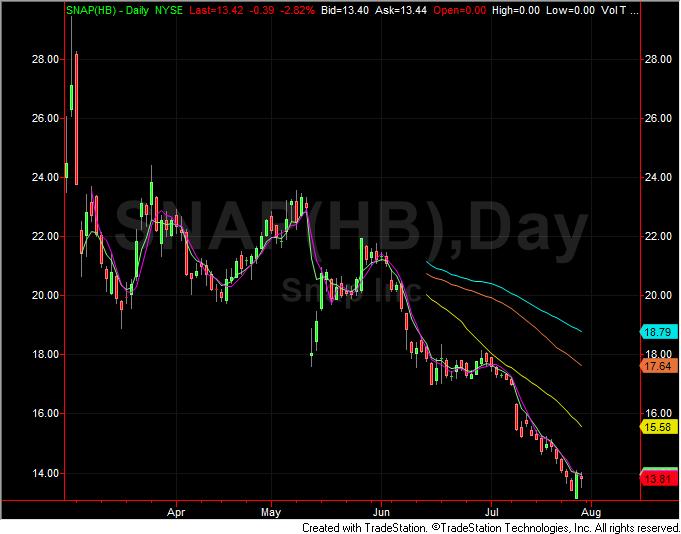
Stock price since IPO:
Snapchat came public on March 2nd, 2017 with a float^1 of approximately 200 million shares. It was priced at $17, opened at $24, hit a high of $29.44 on March 3rd and began it’s decent to the $13.40 (where is was at the time of this analysis (July 31st)). The market capitalization [^1] at the time was approximately $15.9 billion.
Lockup:
I think the end of the lockup period could be significant. Snapchat has 400 million shares unlocking on July 31st and another 782 million on August 14th. In addition, it reports “earnings” on August 10th. For its first quarter as a public company, it reported a loss of $2 billion with $149 million in revenues. On a cashflow basis, they reported $154 million in negative cashflow.
Sharecount:
Snap has a complicated capital structure with approximately 1,178 billion of shares outstanding. If Snapchat doesn’t execute, it could eventually end up being a penny stock. In addition, there are another approximately 195 million in RSU’s and stock options not included in the share count, making the actual number of shares we should be using to calculate market cap 1.373 billion. Furthermore, there are approximately another 2 billion shares authorized to be issued (mostly to be used for stock-based compensation). Can you say dilution?
Trading Opportunity?:
From my point of view, the least risky option is to wait until after earnings and possibly after the August 14th lockup. I want to look further at the stock-based compensation figures, in particular since in Q1 2017, Snapchat reported a loss of $2.2 billion ( $1.9 billion of which was stock based compensation!). The excessive stock based compensation will eventually become an issue as it dilutes the existing shareholders. SNAP’s stock based compensation policy is quite egregious, which I will discuss in a post at a later date. As far as earnings go, analysts will be looking a daily average users and user growth.
I still believe SNAP will provide a decent trading opportunity at some point soon. I will look for a sign of strength on the daily chart with some positive news before buying. (there was one on July 27th, but given the quantity of shares potentially being sold, I prefer to see how it trades this week). I will update this blog after the lockup and earnings.
I have not taken into account the fact that the “A” shares are non-voting, which is analysis for another day and one of the reasons I am looking at this as a trade, not an investment.
Footnotes
1 Market Capitalization is market value of a publicly traded company. It is found by multiplying the shares outstanding by the current stock price.
2 The float is the amount of shares that are eligible to trade on the public market. Not all shares of a company are eligible to be traded. SNAP has 200 million shares that trade, but that is a small percentage of the shares that are outstanding and could potentially provide more supply as lockedup shareholders become eligible to sell.
3 Lockup: When a company issues an IPO, existing shareholders are not usually allowed to sell all of there shares for a specific period of time (usually 3-6 months).
4 RSU : A Restricted Stock Unit is a grant valued in terms of company stock, but company stock is not issued at the time of the grant. After the recipient of a unit satisfies the vesting requirement, the company distributes shares or the cash equivalent of the number of shares used to value the unit.
You should be aware of the risks involved in stock investing, and you use the material contained herein at your own risk. All stock recommendations and comments are the opinion of writer.

 Sveiki Capital